
SIEM enables security teams to collect and analyze security data across their environment, identify suspicious activity, and take action before attackers gain a foothold.
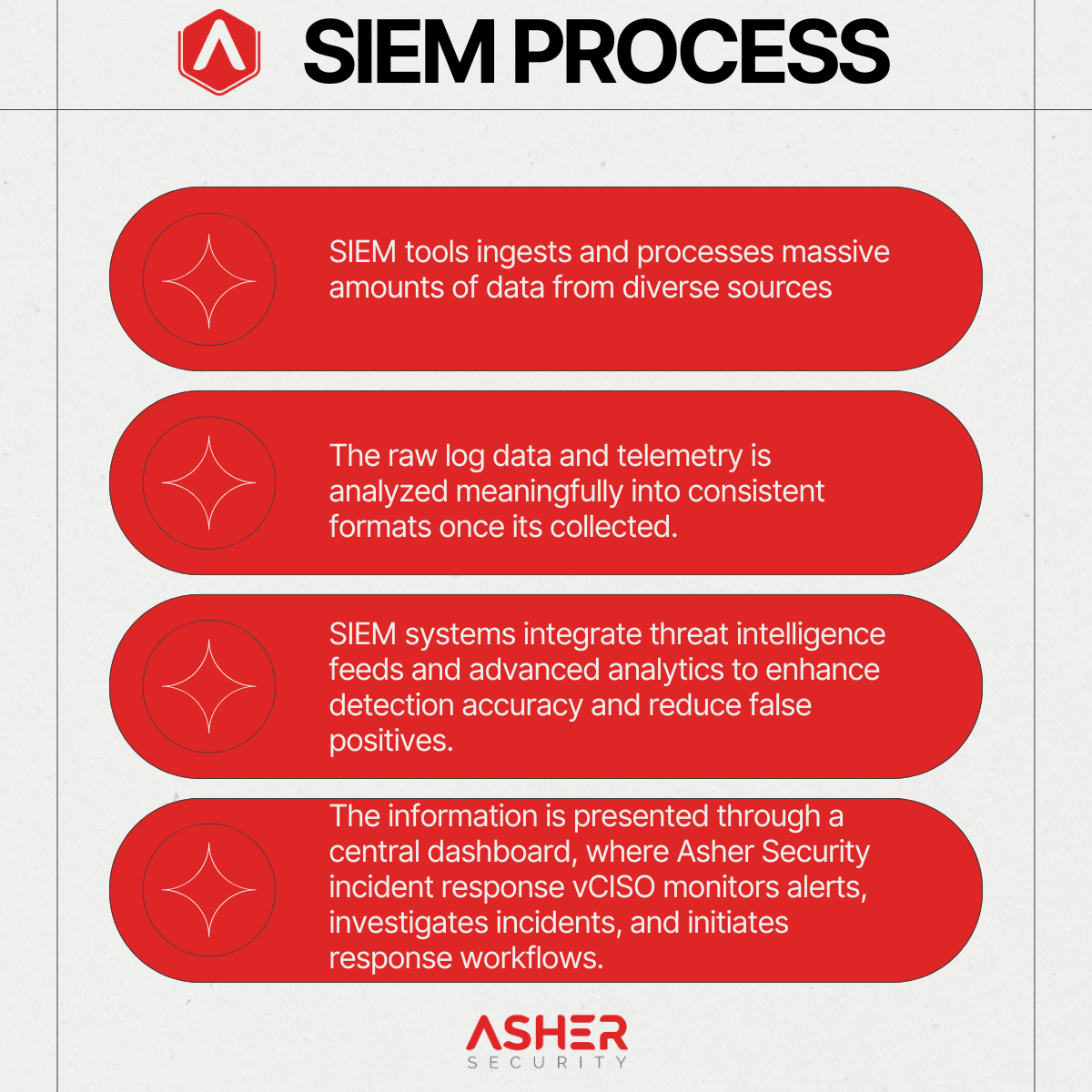
Modern SIEM tools are much more than a mere log collection tool. They help establishments track down deviant user and system conduct, match activities across different systems, and use artificial intelligence to mechanize huge areas of threat identification and incidence response. Such automation is particularly helpful because security teams have to deal with the increased volumes of data, greater attack surfaces, and more advanced attackers.
However, SIEM did not start this way. The initial platforms were mainly log management solutions, which combined security information management (SIM) and security event management (SEM) with support of centralized monitoring and compliance reporting. These initial systems were aimed at gathering, archiving, and searching logs to achieve audit and regulatory demands as well as providing basic real-time notification.
Current SIEM
The SIEM technology has changed and grown over time in response to new security requirements. The current platforms include modern analytics, user and entity behavior analytics (UEBA), machine learning, and threat intelligence to identify inconspicuous signs of compromise that the traditional tools usually overlook. Because of this, SIEM has become an ingredient of the modern security operations center (SOC) serving as a foundation of continuous monitoring and compliance, as well as incident detection and response.
Nonetheless, the implementation of effective SIEM lies not only in the application of the appropriate technology. The implementation decisions, tuning, governance, and integration with the incident response processes are what will make SIEM a strategic security asset or an unused tool. This is the area in which a qualified leadership, such as the leadership of a virtual CISO in Minnesota can contribute to a tangible change.
9 Best practices in SIEM Implementation
Successful SIEM implementation involves more than using a tool and activating the log collection. Companies that do benefit with the SIEM actually engage in a calculated, methodical process; one that prioritizes technology with business risk, realities of operations, and long-term security objectives.
The best practices below describe the manner in which SIEM can be deployed to enhance detection, support compliance, and facilitate the effective response to the incidents.
-
Define the Scope and Security
Among the key SIEM errors frequently committed is the deployment of the platform without knowing what it is supposed to accomplish. Prior to the implementation, organizations should clearly stipulate the scope of their SIEM deployment and its role in supporting the business objectives.
This includes identifying:
- Which are the most important risks to the organization
- What kind of threats should be detected early
- What systems and environments have to be checked first
Instead of trying to keep track of all things simultaneously, effective SIEM programs concentrate on high-value use cases including credential abuse, misuse of privileged access, lateral movement, as well as data exfiltration. It is advisable to start with clear security use cases as it enables teams to gain confidence, prove value, and increase coverage in a manageable manner.
-
Design Correlation Rules Across the Entire Environment
The actual strength of SIEM is that it is capable of correlating the events within several systems. This necessitates deliberate engineering of correlation logic including on-premises infrastructure, cloud systems, SaaS applications, and remote devices.
The successful correlation rules do take into account:
- Authentication-network- endpoint activity relationships.
- Patterns of time that are indicative of abnormal behavior.
- Series of events rather than single alerts.
For example, a single unsuccessful access attempt can be innocuous, but consecutive failures in the systems with the use of multiple lower-level systems and then the acquisition of privileges is not. There should be a consistent application of correlation logic across environments to eliminate blind spots, particularly with hybrid and cloud-first architecture.
-
Align SIEM Configuration With Compliance Requirements
To meet regulatory and audit requirements many organizations turn to SIEM to enable them to capture logs. However merely collecting logs is insufficient. SIEM has to be purposefully set up to observe, signal and report on compliance-related activity in real-time.
This involves the knowledge of:
- What are the rules governing the organization
- What the evidence auditors expect to see
- Period of time logs should be held
- Which activities need to be monitored or alerted
When SIEM is effectively coordinated with compliance issues, it is able to give constant insights into the effectiveness of controls and not scrambling of audits at the end of the week. It also enables security teams to detect gaps in the compliance early before they are transformed into findings or violations.
A virtual CISO can be used to bridge the regulatory language and implementation framework to ensure SIEM reporting is supportive of compliance and security results.
-
Maintain an Accurate Inventory of Digital Assets
SIEM is only capable of observing what it knows exists. The lack of a full and up-to-date inventory of digital assets creates discontinuities in the collection of logs and opens loopholes in the visibility.
For best practice, it is recommended to have a living inventory that contains:
- The network devices, network endpoints and servers.
- Cloud resources and services.
- Applications and databases
- Identity and privileged accounts.
This contextual perspective on alerts is vital; based on this awareness of assets. For example, critical system unusual activity should have a different priority as compared to unusual activity in a low-risk asset. The classification of the assets also assists SIEM in prioritization of the alerts and minimization of noise.
A vCISO may also assist in setting the asset criticality and aligning the SIEM monitoring to the impact of the business, rather than technical indicators.
-
Establish and Monitor BYOD and Configuration Policies
With the growing popularity of remote work and personal devices, the implementation of SIEM should be able to support the Bring Your Own Device (BYOD) environment and non-standard configurations.
Clearly outlined policies must define:
- What gadgets have access to corporate resources
- Minimum security standards of such devices
- Which activities should be tracked and recorded
SIEM must then be set to identify policy breaches, e.g. access by unmanaged devices or unanticipated configuration modifications. This is the visibility that allows mitigating the risks of shadow IT and highlighting possible points of entry that attackers might use.
SIEM alerts are not contextualized without defined policies. In their company, SIEM is an effective enforcement and detection tool.
-
Continuously Tune to Reduce False Positives
One of the biggest reasons SIEM implementations fail is alert fatigue. When the number of false positives is high, analysts will fail to capture critical alerts.
Effective SIEM programs are focused on continuous tuning, which entails:
- Thresholds adjustment by normal behavior.
- Refining correlation rules
- Suppressing of known benign activity.
- The use of behavioral baselines.
Tuning is not a one-time task. SIEM configurations need to vary with the changes in systems and patterns of utilization. Periodic tuning to the services can work to maintain meaningful and actionable alerts.
A vCISO provides control to this process, which balances detection sensitivity and operational reality in such a way that SIEM is not distrusted by the security staff.
-
Integrate SIEM With Incident Response Processes
SIEM is only as effective as the response it enables. Alerts that fail to generate action are of little value. This is why, SIEM should be closely combined with the documented incident response procedures.
Best practice includes:
- Mapping alerts of SIEM to response playbooks
- Defining the escalation paths and ownership
- Training on the scenarios of response
- Enhancing support of investigations through evidence gathering
When SIEM notifications can be directly sent to incident response with a vCISO-managed strategy, organizations react more quickly, put threats in a more effective way, and mitigate the overall effect.
This correspondence makes SIEM more of a decision-making engine rather than a monitoring tool in cases of security incidents
-
Automate Where It Matters
SIEM technologies today are becoming more and more compatible with automation engine technology including SOAR.
Automation can:
- Add contextual data to alerts
- Stop loss measures
- Lessen manual research processes
- Speed up response time
Automation should be applied thoughtfully. High-confidence, repetitive actions are ideal candidates, while complex decision-making should remain human-driven. Automation makes organizations more efficient when properly balanced to avoid unwarranted risk.
-
Consider Managed SIEM or vCISO Support
SIEM is powerful but complex at the same time. There are numerous companies that have trouble with staffing, tuning, and continued management. In such instances, collaborating with a managed provider or using virtual CISO services can be a wise choice.
A vCISO provides:
- SIEM implementation strategic control
- Conformity to risk management and compliance
- Consistent government and fine-tuning leadership
- Reporting and decision support on the executive level
In organizations that do not have a complete SOC or in those that have only a limited number of internal resources, this model facilitates efficient use of SIEM without the teams being overworked.
Conclusion
The effective implementation of SIEM is not a technical gimmick but a strategy that entails coordination of people, process and technology. The SIEM tools can become a formidable force behind the threat detection, compliance visibility, and operational resilience when enforced with a clear purpose, well-defined use cases, ongoing tuning and a robust incident response integration.
Nevertheless, not even the most developed SIEM platform can be effective without appropriate governance and control. Asher Security Incident response using a vCISO can serve as a defining factor. A virtual CISO provides the expertise required to make sure that SIEM is introduced purposefully, aligned to business risk, and constantly optimized as the threat environment changes. vCISO services in Minnesota can assist organizations to transform SIEM data into a resolute action, starting with defining correlation policies and compliance policies to direct response processes and automation plans.
Ultimately, it does not mean that SIEM is merely a matter of visibility, it is a matter of preparedness. And when decent approach and direction are in the mix of it, it is a base of proactive and sustainable cybersecurity.

Tony Asher
Founder, Asher Security • Virtual CISO (vCISO)
Recent Comments